A 35mm frame in photography is a familiar full-frame format measuring approximately 36 × 24 millimeters. Its value is not simply that it captures more than a close crop: it can preserve the relationships between a subject and the surrounding people, places, and details that explain what is happening. By combining field of view, camera position, and deliberate composition, photographers can use a 35mm lens to make images that feel both immediate and contextual. The format’s history, optical characteristics, and practical uses all help explain why a slightly wider view can tell a fuller story.
35mm Frame Context and the Meaning of a Wider View
The phrase “35mm frame” can refer to two related things: the 36 × 24 mm image area of traditional 35mm film, now commonly called full frame in digital photography, or a 35mm focal-length lens mounted on a camera. These are not identical. The sensor or film size determines the recording area; the lens focal length and camera position determine how much of the scene appears in the frame.
On a full-frame camera, a 35mm lens shows a wider angle of view than a 50mm lens from the same position. That broader view can include a subject’s setting without making the scene as expansive as a very wide-angle image. A tight crop can enlarge a face or object, but it removes surrounding information. In documentary, street, travel, and environmental portrait photography, that information may be essential: a doorway can locate a person, a crowd can establish a public event, and tools or signage can reveal what someone is doing.
The distinction matters because a photograph is not only a record of its subject; it is also a selection of context. A 35mm view gives photographers room to include relevant evidence while keeping the central subject prominent. It does not guarantee a stronger image, and it cannot replace a considered camera position, but it offers a useful balance between subject and surroundings.
35mm Frame Field of View Preserves Relationships
Field of view is the extent of a scene recorded by a camera, shaped by focal length and the size of the imaging surface. The International Organization for Standardization’s film-format conventions and camera manufacturers’ specifications identify the standard 35mm still-film frame as 36 × 24 mm. For that format, a 35mm lens has a diagonal angle of view of roughly 63 degrees; the exact figure depends on the lens’s design and how the manufacturer calculates coverage.
This moderate-wide perspective is a practical middle ground. It can include background elements that a tighter lens would exclude, yet it generally avoids the pronounced spatial stretching associated with very short focal lengths when those lenses are used close to a subject. The following related uses show how that broader frame supports different kinds of visual context.
Environmental Portraits Connect People to Place
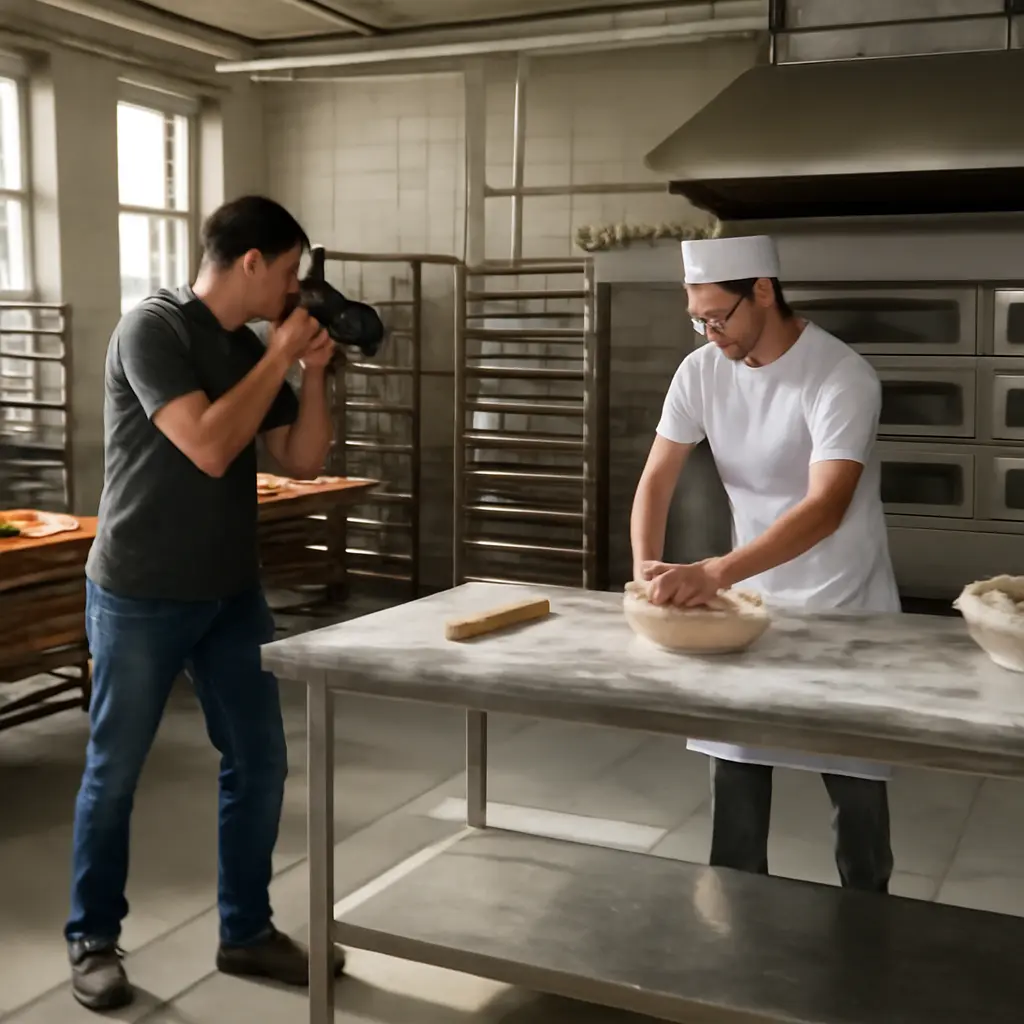
An environmental portrait shows a person together with surroundings that help describe their identity, work, or circumstances. A 35mm lens can frame a craftsperson with a workbench, a chef with a busy kitchen, or a musician with the venue and audience. The setting becomes part of the portrait rather than a decorative blur.
The photographer still needs to control distance and composition. Moving closer makes the subject more prominent but can exaggerate perspective, especially if the camera is very near the face. Keeping a respectful distance and positioning the person within a meaningful part of the scene can preserve both natural proportions and environmental detail.
Street and Documentary Photography Retain Situational Clues
Street photography records public life, while documentary photography uses images to describe people, events, or conditions. In both, context can distinguish a generic portrait from a specific moment. A 35mm frame may show a pedestrian’s interaction with a street sign, a vendor’s stall, or a changing crowd, allowing viewers to infer more about the event.
The wider view also demands careful attention to frame edges. Unintended signs, bright objects, or passersby can compete with the main subject. Photographers can use the extra coverage deliberately by checking the background, choosing a clean camera position, and waiting for people or gestures to align meaningfully.
Travel and Architecture Benefit from Spatial Continuity
Travel photographs often need to show both a landmark and the conditions around it: a square’s scale, a market’s activity, or the relationship between a building and the street. A 35mm lens can retain that spatial continuity while keeping the main subject recognizable. It is often more flexible than a narrow lens when the photographer cannot move far backward.
For architecture, a wider frame can include more of a façade or interior, but perspective still depends on camera placement. Tilting the camera upward can make vertical lines converge. A level camera, a suitable viewpoint, or a perspective-control lens may help manage that effect; the focal length alone does not keep buildings geometrically straight.
35mm Frame Perspective Depends on Camera Position
Perspective is the apparent size and spatial relationship of objects at different distances. It is primarily determined by camera position, not by focal length in isolation. A photographer who changes lenses but keeps the camera in the same place records the same perspective, though the framing changes. If the photographer moves closer to maintain the same subject size with a wider lens, near objects appear larger relative to distant ones, creating a more expansive sense of depth.
This principle explains both the strength and the risk of a 35mm frame. From a moderate distance, it can show a subject in a believable environment. From extremely close, it can make a nose, hand, or foreground object look disproportionately large. The lens is therefore best understood as a framing option that interacts with viewpoint, not as an automatic “natural perspective” setting.
Full-Frame and Crop-Sensor Equivalence
A 35mm lens does not provide the same angle of view on every camera. On a camera with an APS-C sensor, often described with a crop factor near 1.5× or 1.6×, the view is narrower than on full frame. A 35mm lens on a 1.5× crop body gives an angle of view similar to roughly a 52.5mm lens on full frame; at 1.6×, it is similar to about 56mm. These are angle-of-view comparisons, not changes to the lens’s actual focal length.
Photographers choosing equipment should therefore compare equivalent framing rather than relying on the “35mm” label alone. A 23mm lens on a 1.5× APS-C camera, for example, gives an angle of view close to 35mm on full frame. This distinction is especially important when moving between camera systems or following advice written for a different sensor size.
Depth of Field and Subject Separation
Depth of field is the range that appears acceptably sharp in a photograph. It depends on factors including aperture, focus distance, focal length, sensor format, and the final viewing conditions. A 35mm lens can separate a nearby subject from the background at a wide aperture, but it generally includes more surroundings than a longer lens framed to show the subject at a similar size.
That wider environmental view can be an advantage when the background carries meaning. Instead of isolating a face in soft blur, the photographer can retain enough detail to show where the person is and what is happening around them. Aperture and focus can still guide attention, but the surroundings remain part of the image’s evidence.
35mm Frame History and Practical Uses
The 36 × 24 mm still-camera format developed from 35mm motion-picture film. Leica’s early commercial cameras helped establish the compact format for still photography in the 1920s, and it became widely used by photojournalists and other photographers. The “35mm” name refers to the film’s width, including its perforations; the image itself occupies a smaller area, commonly 36 × 24 mm.
That history helped make 35mm a shared reference point for lens comparisons. In digital photography, “full frame” describes a sensor approximately matching the dimensions of the traditional still-film image. The format’s prevalence makes it easier to compare field of view across lenses, but the creative case for a 35mm composition remains practical: it can preserve a subject’s surroundings without requiring an extreme wide-angle perspective.
A Real-World Composition Example
Imagine photographing a baker at work. A tight head-and-shoulders crop may show expression, but it can remove the oven, flour-dusted counter, and trays that identify the activity. A 35mm frame from a considered distance can include the baker and those details together. The photograph then communicates not only who the person is, but what they are doing and where the work takes place.
The same logic applies to a protest, a family gathering, or a travel scene. The surrounding details should be selected, not merely included. A useful test is to ask whether each visible element clarifies the subject, establishes scale, or contributes to the story. If it does not, changing position or waiting for a cleaner moment may be more effective than cropping later.
A Simple Field-of-View Comparison
Consider three full-frame photographs taken from the same camera position: one with a 24mm lens, one with a 35mm lens, and one with a 50mm lens. The 24mm frame includes more of the scene and makes near-to-far relationships feel stronger; the 50mm frame excludes more surroundings; the 35mm frame falls between them. This comparison is a useful mental chart, but the actual impression depends on subject distance, lens design, and composition.
If the camera moves closer or farther between exposures to keep the subject the same size, the perspective changes too. For a fair focal-length comparison, keep the camera position fixed; for a fair subject-size comparison, recognize that changing position changes spatial relationships. This distinction helps photographers make deliberate choices instead of attributing every visual effect to the lens.
Conclusion: Use the 35mm Frame to Show What Matters Around the Subject
The 35mm frame is valuable because it can balance a clear subject with the context that gives the subject meaning. Its field of view supports environmental portraits, documentary and street work, travel scenes, and many everyday photographs. Its effectiveness depends on sensor size, camera position, perspective, and the photographer’s ability to include relevant details while excluding distractions.
Before making a tight crop, consider whether the edges of the frame contain useful information: a location, relationship, action, or sign of scale. Try a 35mm-equivalent view, check the background and corners, and move deliberately rather than assuming a wider lens will solve every composition. For further study, compare the same scene at different focal lengths and distances; the exercise makes clear how framing and viewpoint shape photographic meaning.
Sources: International Organization for Standardization, ISO 1007:2000 Photography—135-size film and magazine, https://www.iso.org/standard/2844.html; Leica Camera, The History of Leica Photography, https://leica-camera.com/en-int/photography/history; Nikon, Understanding Crop Factor, https://www.nikonusa.com/learn-and-explore/c/tips-and-techniques/understanding-crop-factor; Canon Europe, The Camera Basics: Focal Length, https://www.canon-europe.com/get-inspired/tips-and-techniques/focal-length-explained/; Cambridge in Colour, Camera Lenses and Focal Length, https://www.cambridgeincolour.com/tutorials/camera-lenses.htm.