Fine art photography is photographic work made and presented as an artistic expression, rather than solely to document an event or sell a product. Exhibiting it successfully means shaping a coherent experience—from selecting and printing images to choosing a venue, installation, interpretation, and promotion. The scale of the opportunity is substantial: the U.S. Bureau of Economic Analysis reported that arts and cultural economic activity contributed $1.10 trillion, or 4.2% of U.S. GDP, in 2022. That figure covers the broader arts and culture sector, not photography exhibitions specifically, but it underscores the cultural and economic context in which artists present their work.
Exhibiting Fine Art Photography Begins with a Clear Artistic Proposition
An exhibition is a deliberately organized public presentation of artworks in a space and sequence that help viewers encounter them. The International Council of Museums describes a museum as a not-for-profit, permanent institution that researches, collects, conserves, interprets, and exhibits tangible and intangible heritage. A gallery show may not meet that institutional definition, but the core exhibition tasks—selection, interpretation, display, and care—are useful standards for any photographer presenting work.
For a photographer, the exhibition’s artistic proposition is the idea that connects the images and gives viewers a reason to see them together. A defined proposition helps determine which photographs belong, how they should be sequenced, and what a viewer should take away. It also makes practical decisions—such as print size, framing, venue, and wall text—more consistent.
Build a coherent series
A series is a group of photographs connected by a subject, visual method, place, time period, or question. Start by writing a one-sentence description of the project, then assess each candidate image against it. A photograph can be individually compelling yet weaken the show if it repeats another image without adding meaning or introduces a subject the series does not develop.
For example, a project about a changing coastline might combine wide views, close details, and portraits of residents. Those images can vary in scale while remaining connected through the central theme. A sequence that moves from landscape to human experience can help viewers understand the project’s subject without requiring extensive explanation.
Edit and sequence for the viewer
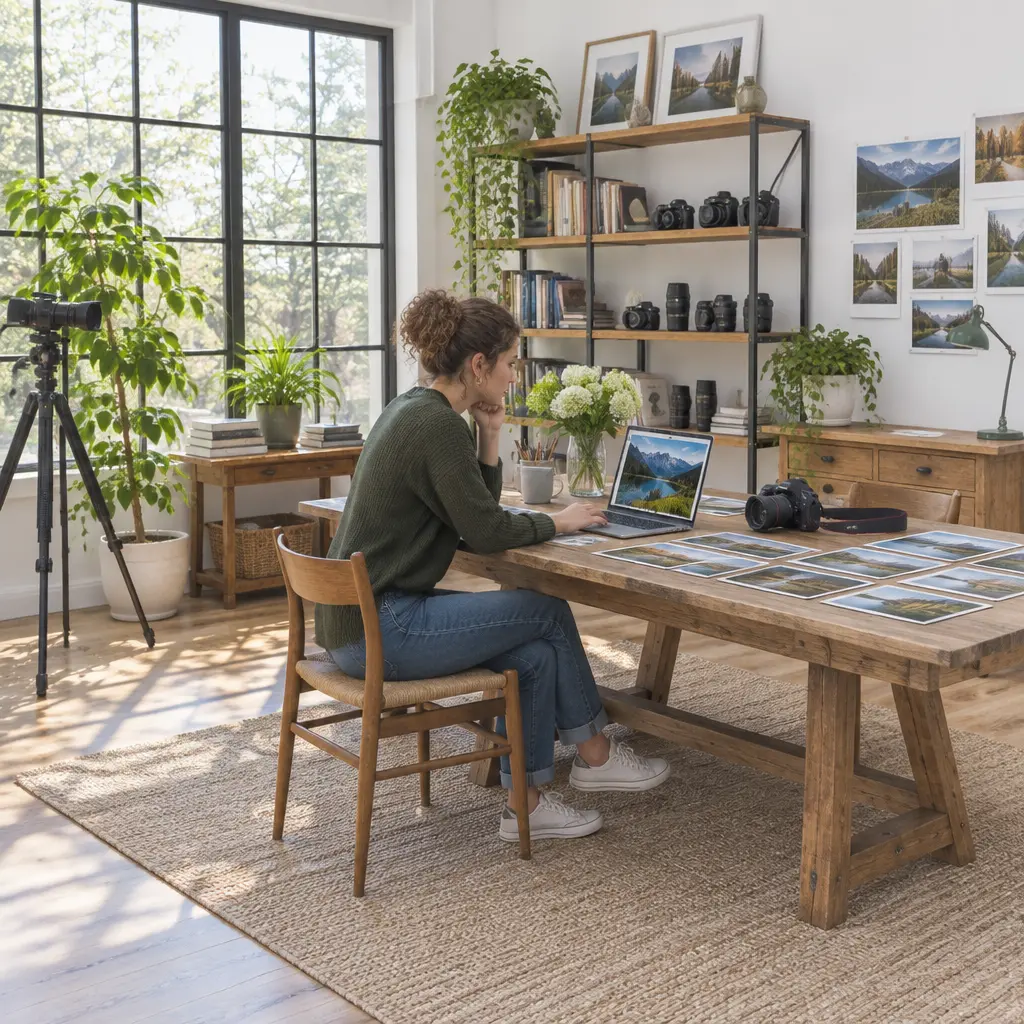
Editing means selecting and removing images; sequencing means arranging the selected photographs so that their relationships unfold across the exhibition. Print contact sheets or make small proofs, then compare images side by side. Look for changes in subject, color, lighting, distance, and emotional intensity. A strong opening image establishes the visual language, while a considered final image can provide resolution or leave a productive question.
There is no universal number of photographs for a show. The available wall space, viewing distance, image scale, and pace matter more than a target count. A compact installation with room around each work may be more effective than filling every wall.
Preparing Fine Art Photography Requires Material and Technical Decisions
Preparing photographic work for exhibition involves turning a digital file or negative into a stable, legible object suited to a particular venue. The Image Permanence Institute at the Rochester Institute of Technology explains that light, temperature, humidity, pollutants, and handling can affect the life of photographic materials. These factors make print choice and installation conditions part of the artistic plan, not merely finishing details.
Choose print processes and materials deliberately
Common approaches include inkjet printing, chromogenic color printing, and traditional silver-gelatin printing. Each produces a different surface, tonal character, and relationship between image and paper. Discuss paper, ink or chemistry, coating, and mounting with a professional lab, and make a test print before committing to a full edition. The right choice depends on the image, budget, intended viewing distance, and the artist’s preference.
For long-term display, ask the lab for written details about the process and materials rather than relying on a broad claim such as “archival.” The Library of Congress preservation guidance emphasizes that storage and display conditions affect collection materials. Avoid placing valuable prints in direct sunlight or near heat, and follow the venue’s recommendations for lighting and environmental control.
Match framing and presentation to the work
Framing protects an artwork and establishes how it meets the wall. Options include glazing with a mat, a float mount, or a presentation without a conventional frame. Use materials and construction appropriate to the print, and ensure the image is secured without damaging it. Reflection-reducing glazing can improve visibility, while a simple frame can keep attention on the photograph; neither is right for every image.
Consistency helps a multi-image series read as one exhibition, though a deliberate change in scale or framing can signal a shift in the work. Before production, confirm each final size, orientation, border, and installation method. Photographing the finished work under neutral light is also useful for documentation and promotional materials.
Plan a practical production budget
A production budget should account for test prints, final printing, mounting, framing, transport, insurance, installation hardware, labels, and possible venue fees. Request itemized estimates and allow time for reprints or repairs. If funding is limited, consider a smaller number of carefully finished works, a shared exhibition, or a venue that provides display equipment. Do not reduce costs by making unclear promises about edition size, print quality, or delivery dates to buyers.
Selecting a Venue Shapes How Fine Art Photography Is Experienced
A venue is not just a container for photographs: its audience, lighting, architecture, access, and schedule affect how people encounter the work. The U.S. National Endowment for the Arts’ Survey of Public Participation in the Arts tracks how Americans engage with arts and cultural activities, including visits to art museums and galleries. Because attendance patterns vary by community and activity, photographers should assess a prospective venue’s actual visitors rather than assume that every gallery audience is the same.
Compare galleries, museums, community spaces, and online shows
Commercial galleries may offer sales support and an established collector audience, while museums and nonprofit spaces may prioritize curatorial context and public programming. Libraries, cafés, universities, and community centers can provide local visibility, but their lighting, security, and installation facilities may differ considerably. Online exhibitions can reach viewers beyond a local area and preserve a digital record, although they cannot reproduce the scale, surface, or physical presence of a print.
When evaluating a venue, ask who manages the installation, who insures the work, whether sales are permitted, what commission or fees apply, and how long the show will run. Visit during open hours to assess foot traffic, wall condition, glare, accessibility, and the distance from which viewers can comfortably see the photographs.
Write a focused proposal
A proposal should make the project easy to understand and evaluate. Include a concise project statement, a short artist biography, a representative selection of images, approximate print dimensions, installation requirements, and a brief explanation of why the work suits the venue. Follow the venue’s submission instructions exactly; an organized proposal signals that the artist can manage both the creative and practical parts of an exhibition.
A useful proposal also clarifies what is still flexible. A curator may suggest a different sequence or scale to fit the space. Treat such discussion as a chance to improve the presentation while protecting the central purpose of the work.
Installing Fine Art Photography Combines Design, Interpretation, and Care
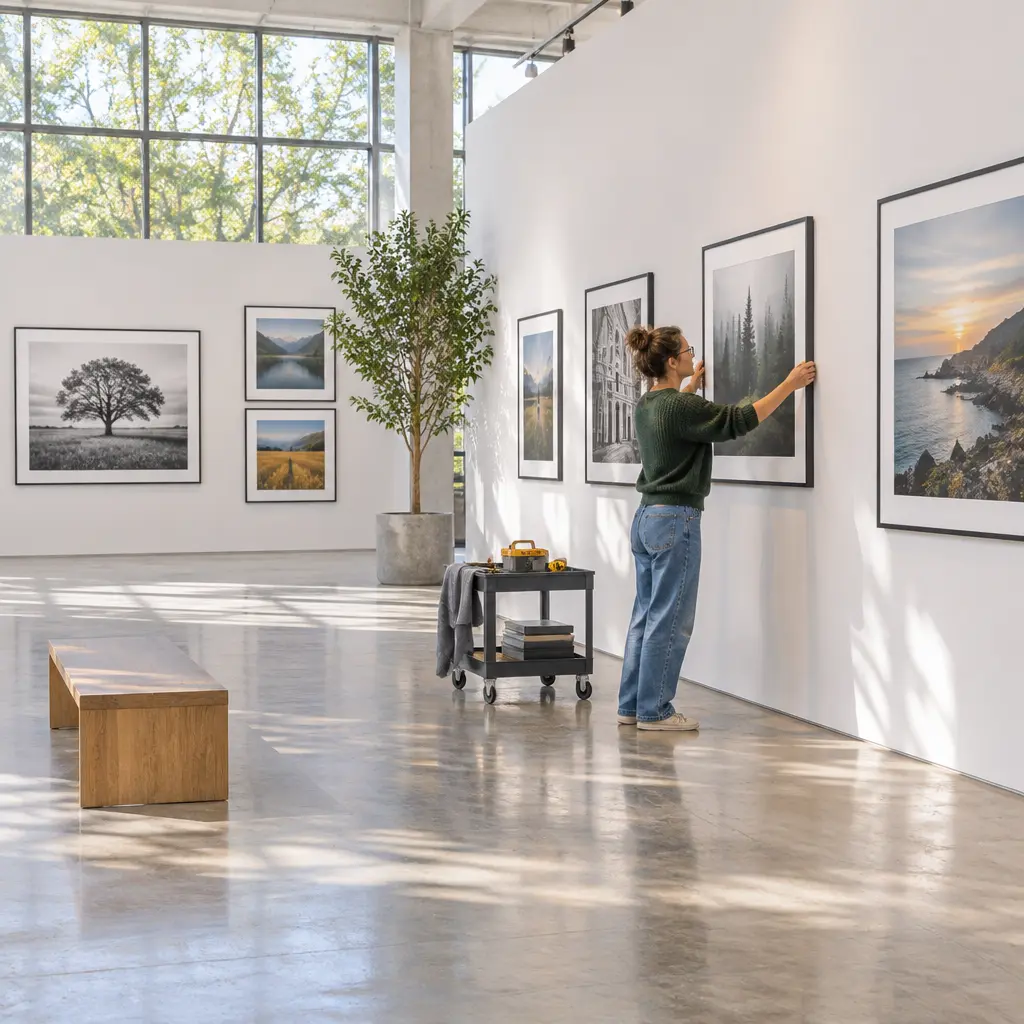
Installation is the arrangement of artworks and supporting information in a physical space. It includes placement, spacing, sightlines, lighting, labels, and circulation. A thoughtful installation helps visitors move through the work comfortably and makes the relationships between images visible.
Map the space before hanging
Measure walls, doors, windows, and obstructions, then sketch a floor plan or make a scaled mock-up. Mark the dimensions of each framed work and test possible sequences on paper or digitally. Hang work at a consistent viewing height unless the room, artwork, or intended effect calls for a deliberate variation. Leave enough space between pieces for each photograph to register independently.
Plan the visitor route as well as the wall layout. Avoid placing a key image where a doorway, reception desk, or strong reflection competes with it. If the venue permits, view the installation from the entrance and from common standing positions before finalizing placement.
Use lighting to support image quality
Lighting influences color, contrast, surface visibility, and preservation. The Illuminating Engineering Society publishes guidance for lighting applications, while conservation organizations caution that light exposure can damage sensitive materials over time. Work with venue staff to avoid direct sunlight, excessive heat, and distracting reflections. Test lighting on the actual framed prints, since glazing and paper surfaces can behave differently from a monitor.
Provide concise, accessible interpretation
Wall text gives context without replacing the viewer’s own encounter with the photographs. A short introductory statement can explain the project’s subject, method, or central question. Individual labels typically identify the artist, title, date, process, and other details relevant to the work. Keep language direct and readable, and make text placement consistent.
Accessibility is part of good exhibition design. Use legible type, strong contrast, clear paths, and labels positioned for comfortable reading. Where possible, provide digital or large-print text and describe images in accessible online materials. The Smithsonian Guidelines for Accessible Exhibition Design offer practical recommendations for planning exhibitions that include more visitors.
Promoting Fine Art Photography Builds an Audience Before and After the Opening
Promotion communicates what the exhibition offers, when it is open, and how people can visit. It works best when it is specific, consistent, and coordinated with the venue. The goal is not simply to announce an opening but to make the work discoverable before the event and keep its record available afterward.
Create a clear announcement and press kit
Prepare a short announcement with the exhibition title, artist name, venue, dates, opening hours, and access information. A press kit can include a project description, biography, selected high-resolution images with captions, and contact details. Confirm image-use permissions and credit requirements before sharing photographs with media or partners.
Use digital channels with a specific purpose
A project page on the artist’s website can serve as the authoritative source for exhibition details, selected images, and updates. Social posts can direct people to that page, while email can reach existing supporters. The U.S. Census Bureau’s American Community Survey documents how internet access varies across households, a reminder that digital outreach should complement—not automatically replace—local posters, community partnerships, and in-person communication.
Offer an opening or public program
An opening reception, artist talk, guided walk-through, or workshop gives visitors a reason to engage with the work and ask questions. A talk can explain process and research without dictating how viewers must interpret an image. Coordinate event timing, capacity, accessibility, photography policies, and staffing with the venue well in advance.
Managing Fine Art Photography Sales and Rights Protects the Work
An exhibition can introduce the work to collectors, but sales and image licensing are separate decisions that benefit from clear documentation. In the United States, the U.S. Copyright Office explains that copyright protection generally arises when an original work is fixed in a tangible medium. Copyright ownership, print ownership, and permission to reproduce an image are distinct matters; a buyer who purchases a print does not automatically acquire reproduction rights.
Set edition and pricing terms in advance
An edition is a declared limit on the number of prints made from a particular image at a specified size or presentation. If you offer limited editions, state the edition size, print dimensions, process, and whether artist’s proofs are included. Keep a record of each print sold and mark it consistently. Open editions may be appropriate for some work, but buyers should be told plainly what they are purchasing.
Research prices for comparable work by artists at a similar career stage, then account for production costs, venue commission, taxes, and shipping. Maintain consistent pricing across direct sales and gallery sales unless there is a clear, disclosed reason for a difference.
Document agreements and care instructions
Use written agreements that identify consigned works, sale prices, commission, insurance responsibilities, payment timelines, return or pickup arrangements, and permitted promotional uses. For sold prints, provide a receipt and basic care guidance, including advice to avoid direct sunlight, damp conditions, and unnecessary handling. For legal questions involving licensing or contracts, consult a qualified professional rather than relying on a generic template.
A Practical Checklist for Exhibiting Fine Art Photography
Use this sequence to keep creative decisions connected to production and logistics:
- Define the project’s central idea and select images that support it.
- Choose a venue whose audience, conditions, and schedule fit the work.
- Confirm image count, dimensions, print process, framing, and budget.
- Make test prints, review the sequence, and proof all labels and text.
- Agree in writing on installation, insurance, sales, commissions, and promotion.
- Plan lighting, visitor flow, accessibility, and any public program.
- Document the finished exhibition and archive images, press, and sales records.
Conclusion
Exhibiting fine art photography is a connected process: a clear artistic proposition guides the edit; printing and framing give the images physical presence; venue selection and installation shape the viewing experience; and promotion, rights, and sales planning support the work beyond opening night. Research from cultural, preservation, accessibility, and copyright organizations offers useful foundations, but the strongest exhibition decisions remain specific to the photographs and their audience. Start by refining one coherent series, then visit potential venues, test materials, and build a realistic production plan before committing to final prints.
Sources: U.S. Bureau of Economic Analysis, Arts and Cultural Production Satellite Account, 2022, https://www.bea.gov/data/special-topics/arts-and-culture; International Council of Museums, Museum Definition, https://icom.museum/en/resources/standards-guidelines/museum-definition/; Image Permanence Institute, Digital Print Preservation Portal, https://www.imagepermanenceinstitute.org/digital-print-preservation; Library of Congress, Care, Handling, and Storage of Photographs, https://www.loc.gov/preservation/care/photo.html; U.S. National Endowment for the Arts, Survey of Public Participation in the Arts, https://www.arts.gov/impact/research/arts-data-profile-series/adp-29; Illuminating Engineering Society, Standards and Lighting Library, https://www.ies.org/standards/; Smithsonian Institution, Smithsonian Guidelines for Accessible Exhibition Design, https://www.si.edu/Accessibility/SGAED; U.S. Census Bureau, American Community Survey, https://www.census.gov/programs-surveys/acs; U.S. Copyright Office, Copyright Basics, https://www.copyright.gov/what-is-copyright/